什么是 Affect?
Such cultural theorists as Brian Massumi and Kathleen Stewart align their work with a Spinozist definition of affect to conceive of it as “virtual” and “autonomous,” co-produced by contingent and shifty assemblages.
Affect theory can extend beyond human beings. → 生态诗歌表达万事万物的情动
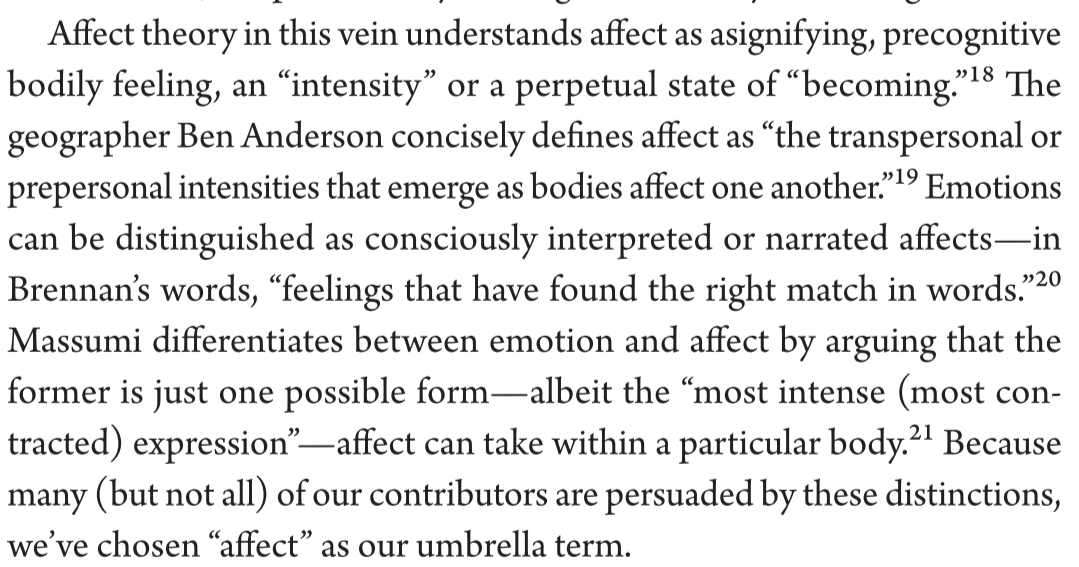
- asignifying - 还未赋予意义的(还未概念化)
- precognitive - 前认知的
- bodily feeling - 身体的感觉
- a perpetual state of “becoming” - 持续生成的状态(还未稳定,chaotic)
Difference Between Emotion and Affect: Emotion is just one possible form of affect - albeit the most intense (most contracted) expression. (Massumi)
情感理论与物质生态批评的共同点是什么?
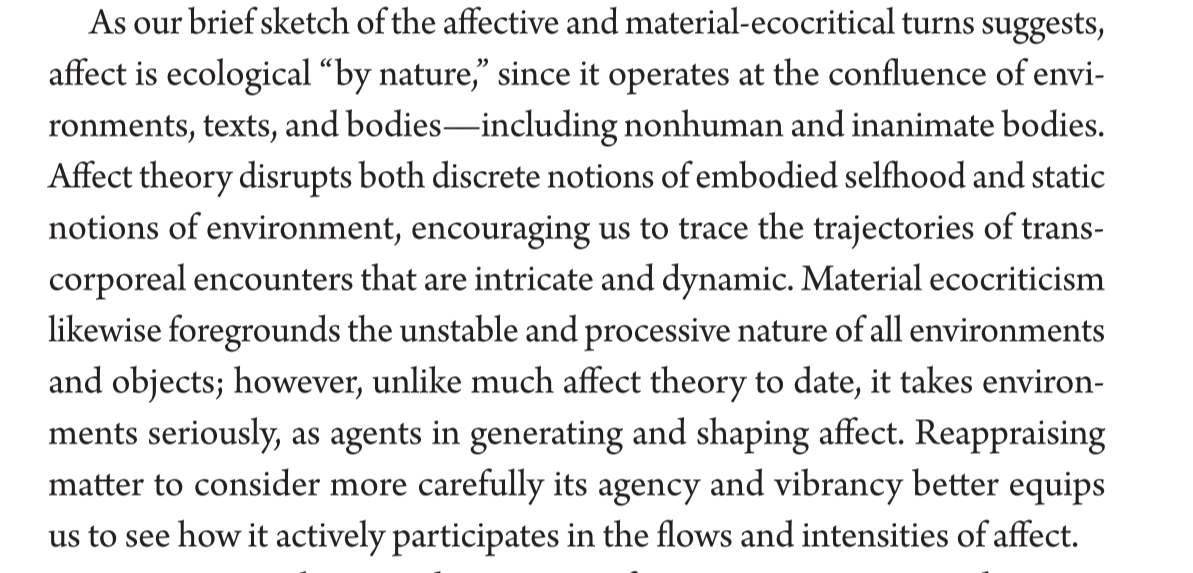
生态批评的第四波浪潮“物转向”的代表前锋 - 物质生态批评关注物质性和具身性,挑战人类中心主义,主张非人类行动者积极参与意义生成与情感流通。这与“情感转向”的关注点有互通之处。
情感理论强调:情感本质上是生态的,因为它在环境、文本和身体(包括非人类和无生命的身体)的互动中起作用。情感理论打破了具身自我的分离概念(身体和心灵二分的观念)和环境的静态概念,强调追踪复杂而动态的跨躯体接触的轨迹(the trajectories of transcorporeal encounters,如人类和环境/动物/物之间的跨躯体性,要求环境或物有能动性)。物质生态批评同样强调了所有环境和物体的不稳定性和进步性(两者都强调主体 - 情感和自然 - 必须同时被理解为物质和意识形态),标志着情感理论和生态批评理论结合起来的时机。
情感生态批评是以物质生态批评为基础,只有物质生态批评承认环境和物的能动性,才有情感生态批评的产生。
以往批评家如何在生态批评中研究情感问题?
- Yi- Fu Tuan’s “topophilia” and E. O. Wilson’s “biophilia” gained traction in ecocriticism’s early phases, offering portable terminology and interdisciplinary perspectives on positive feelings about places (often encapsulated in the phrase “sense of place”).
- Simon Estok countered these phrases with the introduction of his early and abiding example of ecocritical attention to affect: “ecophobia,” the “contempt and fear we feel for the agency of the natural environment.”
- Lawrence Buell wrote of “ecoglobalist affects” in another notable, if underexplored, early reference. Some of ecocriticism’s “new voices” are beginning to speak the language of affect theory more fluently.
- Sarah Ensor’s “Spinster Ecology” suggests attending to nonreproductive “figures like the spinster might inspire a queer ecocritical practice attentive to affects customarily considered too weak or quiet to be politically efficacious.”
- Sylvan Goldberg’s standout chapter in the collection New International Voices in Ecocriticism draws helpfully on Ngai’s Ugly Feelings to call for increased attention to “a quieter range of affective engagements,” including “eco-irritation.”
- In Ecosickness in Contemporary U.S. Fiction: Environment and Affect, Houser theorizes what she calls “narrative affect,” a provocative if tightly focused way of defining what affect can do and how it works.
- Alexa Weik von Mossner’s Affective Ecologies: Empathy, Emotion, and Environmental Narrative explores readers’ engagements with environmental narratives, draws on cognitive narratology and neuroscience, and theorizes affect in relation to these fields.
- Nicole Seymour’s award-winning Strange Natures: Futurity, Empathy, and the Queer Ecological Imagination (非主流的人与自然的关系) and Bad Environmentalism: Irony and Irreverence in the Ecological Age bring together affect theory and ecocritical theory along with a third discipline: queer studies.
- In Bad Environmentalism, Seymour’s compelling argument for the addition of “bad” affects— such as gaiety, irony, humour, and irreverence.
- Joyce Davidson, Liz Bondi, and Mick Smith’s Emotional Geographies and Tonya K. Davidson, Ondine Park, and Rob Shields’s Ecologies of Affect: Placing Nostalgia, Desire, and Hope were among the first to focus primarily on affect in relation to place.
- Christine Berberich, Neil Campbell, and Robert Hudson’s Affective Landscapes in Literature, Art and Everyday Life: Memory, Place and the Senses assesses affective landscapes in an impressive range of visual and literary texts, predominantly using cultural studies and an understanding of affect informed by Spinoza, Massumi, and Stewart.
- Lisa Ottum and Seth T. Reno’s Wordsworth and the Green Romantics: Affect and Ecology in the Nineteenth Century, like our collection, puts affect theory and ecocriticism into conversation, and we share its premise that “a wide range of affective experiences and literary emotions are potentially ‘green.’”
- Weik von Mossner’s Moving Environments: Affect, Emotion, Ecology, and Film made strides in bringing together scholarship on affect and environments— as did Adrian Ivakhiv’s Ecologies of the Moving Image: Cinema, Affect, Nature — within a film studies framework.
情感生态批评有哪些核心内容?
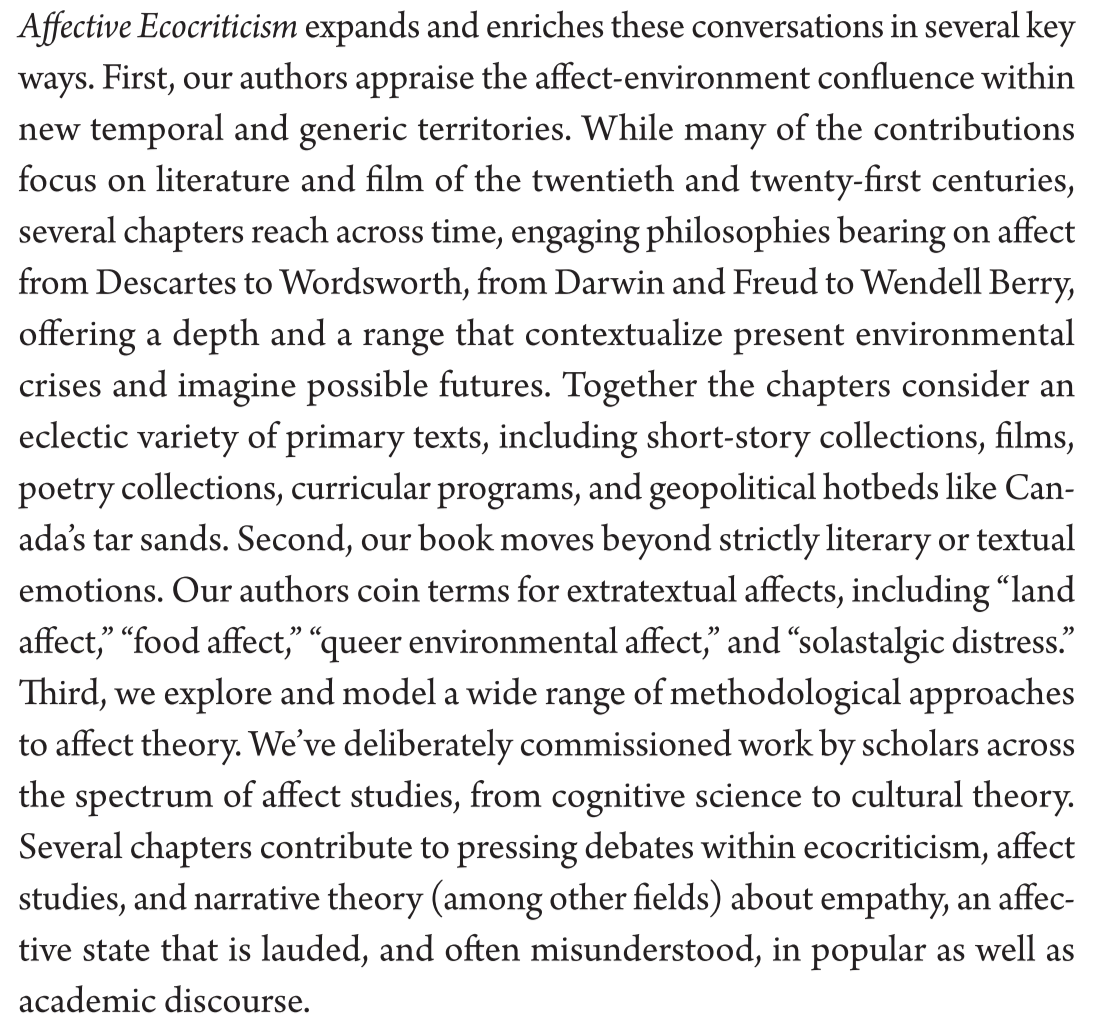
- 情感生态批评旨在识别当前围绕环境议题所引发的情感流动,阐明其运作机制,承认环境本身在塑造情感体验中发挥的决定性作用,并揭示当代社会中涌现的新情感形态。(P4)
- 情感生态批评通过以下方式更直接地考察情感与环境的关系:以空间术语重新构想熟悉的情感、扩展环境情感的范畴,并通过生态批评理论的视角识别出更易理解的新情感。(P6)
- 新兴的“人类世情感”:情感生态批评特别关注在人类世背景下涌现或凸显的负面情感,如“气候悲伤”(climate grief), “人类世焦虑”(Anthropocene anxiety),“乡痛症”(solastalgia,因环境恶化导致的乡愁)等。这些情感不再是个体情感,而是对生态灾难的集体性反应。
文学与情感

阅读文学作品 → 揣摩人物/作者的内心世界,追踪其情感,但很多时候表露的只有行动 → 如何识别情感经验?
摘自金雯《西方文论》第三章第一节“文学与情感”:
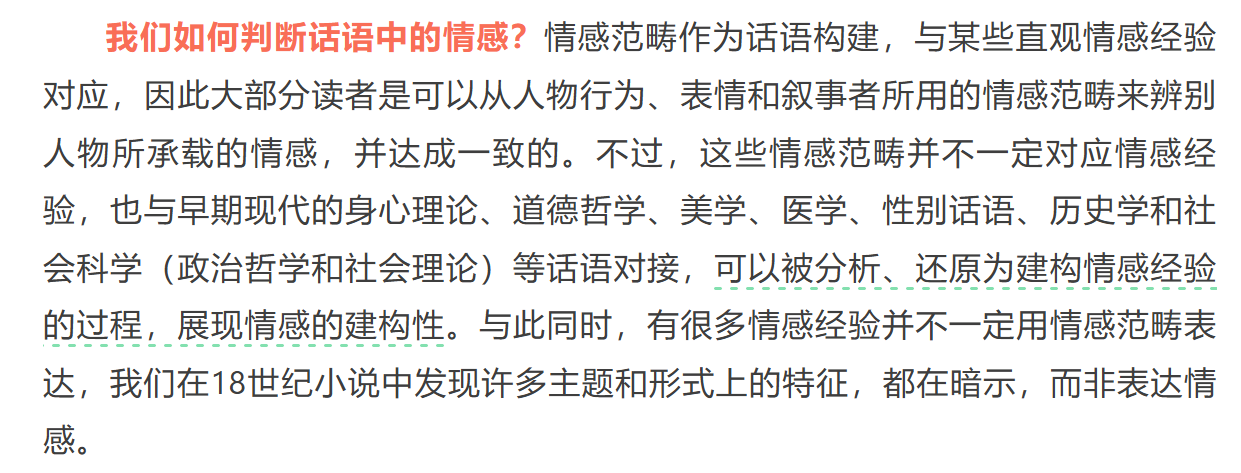
- 情感范畴:如果文学作品中直接出现“悲伤”“惊讶”等字眼,那自然会给予读者较大的提示。
- 情感征兆:文学作品经常对人物的行为举止进行描绘,也会通过内心独白和心理转述等手段描绘内心活动,但不直接使用表示情感范畴的词汇来对人物的情感状态加以揭示。与此同时,有很多情感状态是复合而模糊的,可能是有意识情感和无意识情感叠加和交织而成的。这时候,读者只能以文本中包含的线索和征兆为依据推测人物的情感状态。
- 情感特质:文学中的情感不仅与虚构人物有关,也与作品整体的精神取向有关,在抒情诗中与言说者相连,在叙事作品中与叙事声音相连,有时候显现为“语调”,有时候显现为“美学特征”。倪迢雁曾分析“语调”(tone)这个叙事元素,认为在形式分析中“语调”经常被理解为“态度”或“立场”,但其实这两者都与情感相关。对文学作品“语调”的解读是对文本总体价值取向的解读。比如“偏执”(paranoid)这种情感基调被认为是后现代小说中常见的情感基调,托马斯·品钦的小说《拍卖第49批》(1966)是其中的代表。
- 情感暗示:文学作品中看似与人物情感无关的细节和描写都可能是某种情感的暗示。《包法利夫人》是最为著名的文学案例,小说中包含大量对城市、小镇、农庄自然风光和家居物什的描写。这些描写不仅还原了历史背景,而且具有重要的情感功能:一方面以景写情,暗示人物情感;另一方面暗示叙事者看待景物的方式,隐含对包法利夫人追求感官和情感满足的方式的批判,提示她摆脱自身狭窄视野的可能。
思考:文学作品有哪些方式表现物的情感?完全是拟人吗?有什么传统?某个作品中的特殊表现方法?表现了什么主题?